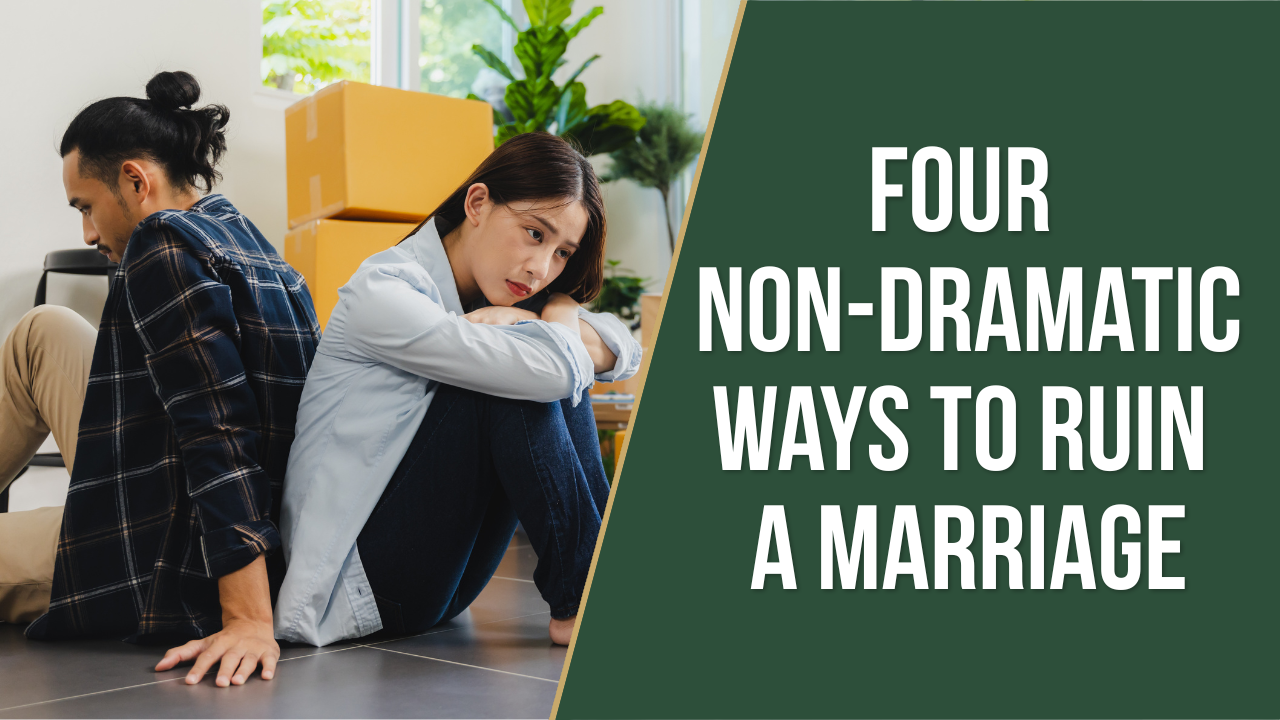
When people think about what ruins a marriage, they often think about dramatic events like adultery, abandonment, or explosive arguments.
But some marriages deteriorate through much smaller things that happen repeatedly over time. One forgotten apology or one neglected evening shouldn’t topple a marriage, but when unhealthy habits become patterns, they can slowly weaken a marriage.
Therefore, here are four non-dramatic ways to ruin your marriage.
- Not Forgiving Small Offenses Can Ruin a Marriage
One of the easiest ways to damage your marriage is to hold on to small offenses instead of forgiving each other.
Your spouse says something insensitive. They forget to do something they promised. They respond irritably when you’re trying to have a conversation. None of these things necessarily represents a major marital crisis. But if you continually hold on to these offenses, they can grow into resentment.
Whenever possible, we should practice Proverbs 19:11, “Good sense makes one slow to anger, and it is his glory to overlook an offense.”
Sometimes, however, you can’t overlook an offense unless you address it and your spouse apologizes. If you don’t learn when you can truly let something go and when you really need to bring it up, resentment will slowly build.
Instead of addressing the issue appropriately and then letting it go, you might keep bringing it up in your mind. You might start viewing your spouse through the lens of their mistakes. Eventually, even their innocent actions can irritate you because you’re carrying around unresolved frustration from previous interactions.
Hebrews 12:15 warns Christians to watch out for a root of bitterness that can grow and cause trouble. Bitterness rarely appears overnight. Often, it develops when we repeatedly choose to nurture our grievances rather than pursue forgiveness.
Ephesians 4:32 says, “Be kind to one another, tenderhearted, forgiving one another, as God in Christ forgave you.”
A healthy marriage requires both spouses to become good at letting small things go, either through individual internal effort or through having a healthy conversation about the offense.
If you keep letting things linger even though they seem small, that’s when big problems are formed.
- Not Confessing Small Offenses Can Ruin a Marriage
This second negative habit is the opposite of the first. Sometimes we know we were wrong, but we don’t want to admit it because the offense seems insignificant.
Maybe you snapped at your wife because you were tired. Perhaps you made a sarcastic comment that embarrassed your husband in public. Maybe you were distracted during a conversation and responded in a way that made your spouse feel unimportant.
You might tell yourself it wasn’t a big deal. You might reason that apologizing would be unnecessary or awkward. So you move on without acknowledging what happened.
Over time, these small moments communicate that you don’t really care about your spouse. Even if you really do care about them, not being able to proactively confess your wrongs before they bring them up communicates to your spouse that your comfort is more important than your marriage.
James 5:16 says, “Therefore, confess your sins to one another and pray for one another, that you may be healed.” Honesty and humility create opportunities for healing, while pride often prevents it.
- Getting Too Busy for Each Other Can Ruin a Marriage
You have jobs to manage, children to raise, bills to pay, household responsibilities to handle, church activities to attend, and personal goals you want to accomplish. All these things can be good and necessary.
But if you’re not careful, your marriage can become another responsibility you maintain rather than a relationship you actively cultivate.
You might live in the same house, coordinate schedules, discuss the children, and take care of practical needs. Yet you might rarely have meaningful conversations. You don’t spend much time enjoying each other’s company. When your spouse wants to connect emotionally, you’re too exhausted or distracted to engage. Eventually, you can start to feel more like roommates than like husband and wife.
In Song of Solomon 2:15, the beloved warns about the little foxes that spoil the vineyards. In its original context, this is poetic language within a love relationship, but it offers a helpful picture of how seemingly small things can damage something valuable.
Busyness can become one of those little foxes.
Your marriage may not be suffering because of one major failure. It may be suffering because you continually sacrifice your relationship for other demands, assuming you’ll reconnect when life slows down.
But life doesn’t always slow down. Ecclesiastes 4:9-10 explains that two are better than one because they can help each other when one falls. Marriage is meant to be a partnership in which spouses support one another, not simply two people managing separate lives under one roof.
One busy season won’t necessarily damage your marriage, but a lifestyle in which your spouse consistently receives whatever time and energy you have left can slowly weaken your connection.
- Allowing Bad Outside Influences Into Your Marriage Can Ruin a Marriage
Proverbs 11:14 teaches that there is safety in an abundance of counselors.
But not every counselor is wise, and not every person offering relationship advice has your marriage’s best interests in mind.
You might get sucked into a toxic social media cycle where the algorithm keeps feeding you countless people saying the same worldly advice, bashing the opposite sex. While it feels like everyone in the world is giving you this advice, which makes the advice feel true, really, the algorithm is just serving our itching ears what they want to hear (2 Timothy 4:3).
Or perhaps you have a family member who’s been through a terrible divorce. And now they start projecting their skewed vision about relationships onto you. If you’re not careful, you will let their toxic attitude infect your marriage.
Proverbs 13:20 says, “Whoever walks with the wise becomes wise, but the companion of fools will suffer harm.”
Before you listen to someone’s advice, ask yourself, “Does this person have the type of marriage I would want?” If they can’t manage their own life, then don’t let them manage yours.