
You might have assumed I’d highlight a verse about marriage, like Ephesians 5:22-33. Or maybe a verse from Song of Solomon. Or, maybe even something about being equally yoked with the right person, like 2 Corinthians 6:14.
While all of these passages could be very helpful in identifying your future spouse, today I want to take a step back and unpack a passage of Scripture that is more of a “convergence verse.” By “a convergence verse,” I’m referring to a passage where God’s guidance is given through more than one channel at the same time, rather than through a single sign, feeling, or command.
Therefore, by studying Proverbs 3:5-6, I believe we can identify three general principles for discerning God’s will for your life. And then we will apply each principle to the specific goal of rightly identifying the person God wants you to marry one day.
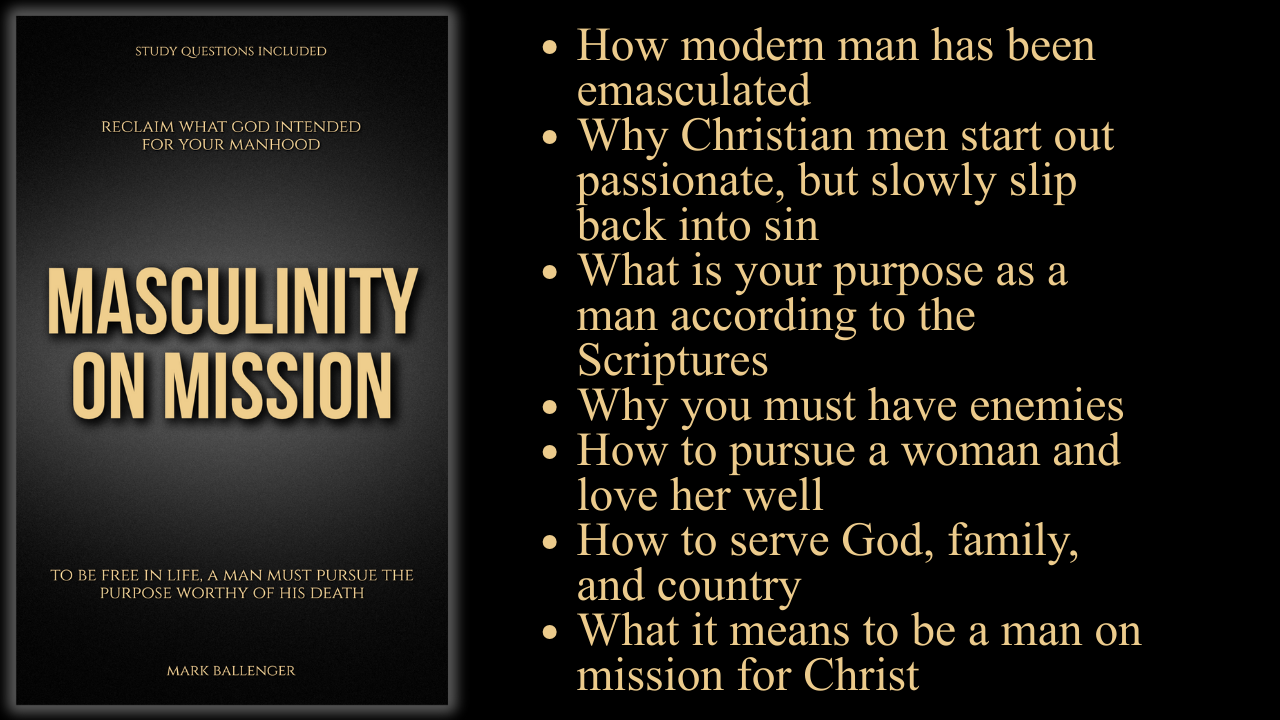
I also wanted to quickly let you know about my new book that was just released today. It’s called Masculinity on Mission: Reclaim What God Intended for Your Manhood. And to celebrate the launch of this book, I’m giving away two of my most important courses at AGW University, along with 7 of my other books (in PDF format). I’ll share more about this new book and how to get the bonus material at the end of this article.
1. You Can Identify the Person God Wants You to Marry Through Objective Biblical Morality
Proverbs 3:5-6, “Trust in the Lord with all your heart, and do not lean on your own understanding.”
In Hebrew, the phrase “trust in the Lord with all your heart” actually expresses two kinds of trust. The first part says “Trust [bĕṭaḥ] in [ʾel]”. The second part says trust God “with [bĕ] all your heart.” So we have [bĕṭaḥ] for trust, but with two different prepositions, trust “in” (ʾel) and trust “with” (bĕ). The preposition “ʾel” denotes motion and direction. It’s saying “trust to” or “trust towards” the Lord. In what direction should you trust? Towards God. The preposition “bĕ” denotes location. It’s saying “rest within” God or “position your rest in” God. Where should you trust God? Within your heart.
Therefore, when Proverbs 3:5 tells us to “trust in the LORD with all your heart,” instead of saying, “place all your trust on God once,” it’s more like saying, “Keep aiming your trust toward the LORD as your default posture.” It describes a habitual leaning of the heart, the way a compass needle keeps pointing north.
This verse is not saying:
- “Don’t think”
- “Ignore your reasoning”
- “Check your brain at the door”
Instead, it’s warning against making your own reasoning the final authority.
But how can you do this? How can you know if you are actually trusting God continually and headed towards him, or if you are just believing whatever you want as you follow your own feelings? Answer: We need objective moral laws that we can continually go to as we persistently use our reasoning skills to gain godly insights.
Can you see how this is so important when it comes to identifying the person you want to marry? So many Christians think they should just be able to hear God say once and for all, “That is the person you will marry.” But when we apply Proverbs 3:5, that’s not the biblical norm. Rather, the biblical norm is to continually come back to God’s truth and rely on it over and over again. And when we do that, that’s when God will make his will clear to us about who to marry.
You can’t just look up one Bible verse one time when you first meet someone and then conclude that this relationship is biblical and thus you have met the person God has for you. As you keep interacting with someone, you need to keep assessing all the information you are gathering through a biblical lens.
As time goes on and you continue to apply biblical truths that the Lord will reveal to you in your daily devotions, the Lord will direct your steps towards the person he wants you to marry.
2. You Can Identify the Person God Wants You to Marry Through Subjective Experiences with the Holy Spirit
Proverbs 3:6, “In all your ways acknowledge him . . .”
For the word “acknowledge”, the Hebrew is “yādaʿ”. It denotes “to know him”. This word connotes “direct acquaintance” and should not be thought of as an impersonal observance.
For example, we can “acknowledge” the speed limit and obey it. But that is impersonal and not at all what this verse is pointing to. When this verse says we are to “acknowledge” the Lord, it’s talking about something much more personal. In fact, the same Hebrew word is used in Genesis 4:1 when it states, “Now Adam [knew] [yādaʿ] Eve his wife, and she conceived . . . .”
Therefore, it’s clear that when Proverbs 3:6 states “In all your ways acknowledge [yādaʿ] him” that this means something more than obeying the objective moral law expressed in his commands. And this is consistent with all of Scripture. Not only does God guide us through unchanging Scripture, but he also guides us through our personal encounters with the Holy Spirit.
There are many decisions in life that are neither morally wrong nor right. Marriage often falls into this category. Yes, you could choose to marry someone and in the process violate a command in Scripture, such as marrying an unbeliever (2 Corinthians 6:14, 1 Corinthians 7:39). And yet, there are millions of Christians you could marry from a biblically objective standpoint. Clearly, however, God doesn’t just say, “I don’t care who you marry. As long as it meets the letter of the law, I have nothing to say to you about this.”
To be clear, I’m not insinuating that there is one perfect soulmate for everyone, as though, if you were to marry “the wrong person,” that you would set off a cosmic chain of events that leads to many others marrying the wrong person too. That is an unbiblical view of God’s sovereignty because it assumes that humans could violate what God has sovereignly ordained. When God sovereignly ordains something, it doesn’t violate human free will. Rather, in a way we can’t fully comprehend, God sovereignly works through our free wills.
So in that sense, I do believe in the concept of “the one” when we mean it as “the person God wants you to marry.” I believe there is an actual person out there God has planned for you to marry, if you’re called to marriage. And to find this person, you will not only need to follow the Scriptures, but you must also follow the Holy Spirit’s personal leading in your life.
As Genesis 24:14 states, “let her be the one whom you have appointed for your servant Isaac.” In the NLT it reads, “let her be the one you have selected as Isaac’s wife.” In the NIV it states, “let her be the one you have chosen for your servant Isaac.” Notice the words used here: “appointed,” “selected,” and “chosen.” So don’t tell me there is no biblical evidence for “the one.”
There’s no “perfect one” for you. But God cares about who you marry. And if you are following the Spirit’s personal leading, he will help you identify this person.
3. You Can Identify the Person God Wants You to Marry By Submitting to the Situations God Is Sovereign Over
Proverbs 3:6, “. . . and he will make straight your paths.”
The Hebrew for “he will make straight your paths” in Proverbs 3:6 is “hûʾ yĕyaššēr ʾōrḥōtekā.”
- hûʾ — “he” (independent personal pronoun, emphasizing God as the active subject)
- yĕyaššēr — “will make straight” or “will direct” (from the verb yāšar, meaning to be straight, right, or to direct)
- ʾōrḥōtekā — “your paths” (ʾōrḥōt = paths; kā = your, second person masculine singular suffix)
This is not merely moral guidance but active intervention. The Lord is pictured as personally clearing, leveling, and aligning the path so it leads where it should. In the ancient Near Eastern context, yāšar often carried the idea of, preparing a road for travel, removing uneven ground, making a path passable and safe
So the promise is not: “God will tell you the right direction,” but rather: “God will actively straighten the road you must walk.” The inclusion of the independent pronoun hûʾ before the verb emphasizes God’s personal agency—it’s not merely that paths will be straightened, but that God himself will actively straighten them, underscoring divine involvement in guiding one’s way.
In other words, God isn’t the divine clockmaker. He didn’t just make everything, set it all in motion, and then removed himself from our personal lives. No! God is Immanuel, “God with us.” And yet, he is also El Shaddai, “God Almighty.” He is immanent and close, while also being transcendent and above.
What are the implications of all of this for you as you seek to know who you should marry? This means that not only must you look at the word of God, and not only must you consult the Holy Spirit’s personal leading in your heart, but you must also look at the events, opportunities, and paths in your life and acknowledge that God is in control of them.
When God doesn’t want you with someone, the facts of life will make this clear. You might still be able to rebel and disobey God, but this will manifest in bad fruit (Galatians 5:19). And when God is leading you to marry someone, not only will the necessary doors be open in your life, but the fruit you and this person are producing will be biblical (Galatians 5:22).
As I mentioned at the beginning of this article, my new book was just released. It’s called Masculinity on Mission: Reclaim What God Intended for Your Manhood.
The thesis statement for this book is, “To be free in life, a man must pursue the purpose worthy of his death.”
The world is lying to us. Everywhere a man looks, the messaging has been carefully orchestrated to keep him in bondage: “Just do what makes you feel good. Pain is evil. Responsibility is a burden. Sacrifice is bad.” And yet, Jesus said, “For whoever would save his life will lose it, but whoever loses his life for my sake will find it.”
What if the most dangerous thing in our lives as men is a desire for safety? What if the reason men feel so unfulfilled is that we are spending so much time trying to fill ourselves? What if the freedom you long for is actually locked behind the sacrifices you are running from?
In Masculinity on Mission, you will learn:
- How modern man has been emasculated
- Why Christian men start out passionate, but slowly slip back into sin
- What is your purpose as a man according to the Scriptures
- Why you must have enemies
- How to pursue a woman and love her well
- How to serve God, family, and country
- What it means to be a man on mission for Christ
At the end of each chapter, I’ve included 10 reflection questions and extra-credit assignments that can be used for small-group studies or individual devotional times.
Lastly, for everyone who purchases this book before the end of February 10th, you will get lifetime access to two of my most important courses, The Mind of a Woman and The Mind of a Man. These courses will help you understand the core differences between men and women, equipping you with the skills to thrive in a relationship. You will also get lifetime access to 7 of my other books in PDF format. Click here to learn more about the bonus material.
All you need to do is purchase Masculinity on Mission before 2/10/2026. Send your proof of purchase (receipt or screenshot of receipt) to bonuscourse@applyGodsword.com. You will then get instant access to this bonus material.
Click here to purchase your copy!


You may also like:
- This Verse Separates the Boys from the Men (1 Corinthians…
- 3 Signs God Is Saying, “She’s the Wrong Woman for…
- This Verse Will Prevent You from Missing God’s Blessing
- 5 Biblical Marks of a Woman Who Would Complement (Not…
- 5 Biblical Marks of a Man Who Would Be a…
- 3 Ways Satan Hides Someone Sent as an Answer to…