
Loyalty and love. Are these not one in the same? When loyal you are loving and when loving you are loyal. Love remains because it’s loyal, and loyalty exists because of love. Who can separate these two?
Loyalty and love. Are these not one in the same? When loyal you are loving and when loving you are loyal. Love remains because it’s loyal, and loyalty exists because of love. Who can separate these two?

While there is really only one true God, in our fallenness we often times idolize many other things, thus treating them like gods. But how do we identify idols of the heart?
Control is the name of the game when it comes to being a god or God. One of the qualities of divinity is doing what you want, when you want, and why you want. This truth can help us identify idols of the heart.
When we idolize someone or something, we will be controlled by them. Therefore, if you want to know what your gods are, all you have to do is identify what controls you.

How do you forgive someone who has hurt you deeply? Sadly this is a question every human will have to answer if they hope to keep their heart healthy.
If you have close friends, relatives you love, a spouse, children, or any other significant relationship, the possibility for hurt will never leave and thus forgiveness will always be deeply needed.
Therefore, the first step in forgiving someone who has hurt you deeply is to prepare in advance before the hurt even happens.
Perhaps the caring heart and character of God is the first lesson Jesus teaches us about in this parable because this is foundational to our desire in pursuing the Lord. If we don’t know he cares for us, why would we pray to him?
1 Peter 5:7 (NIV) states, “Cast all your anxiety on him because he cares for you.” Peter motivates us to cast all our troubles onto the Lord by reminding us that God really does care. God really is good. If you don’t know he cares for you, if you don’t know that the heart of God is for you, or if you doubt the goodness of God, you won’t pray very much.

If you’re like everyone else who has ever lived on planet earth, you’ve probably experienced some confusion about your life. What am I supposed to do with myself? How can I make more money? When will I meet my spouse? Should we buy this house or not? Why is life so difficult?

Early on in my marriage, I learned it is all too easy to masquerade an accusation as a question. With a harsh tone and a rushed demeanor, the question “Where are my keys?” was really the accusation, “You put my keys somewhere they don’t belong!” With a harsh tone and furrowed brow, the question “Are you mad at me?” was really the accusation, “You have no right to be mad at me!”
Obviously this was not helpful to our marriage. Things only got better when I realized “asking” a question with a negative spirit is the same thing as accusing. I knew better than to just accuse my wife of doing something wrong, but subconsciously it felt more acceptable to phrase my accusation as a question.
In reality, though, the difference between asking and accusing lies not in the phrasing but in the motivation.
 Now about food sacrificed to idols: We know that “We all possess knowledge.” But knowledge puffs up while love builds up. Those who think they know something do not yet know as they ought to know. But whoever loves God is known by God.-1 Corinthians 8:1-3
Have you ever met a Christian, or someone who claims to be, where all they want to do is war about words and ideas?
There is certainly nothing inherently wrong with being a man or woman of study. I personally really enjoy studying and gaining more knowledge. God has given us our minds and surely he expects us to know as much information about him and his word as we are able to gather. However, as Paul explains in 1 Corinthians 8:1-3, knowledge alone puffs up and does not accomplish God’s ultimate desire for us, which is to love him and build others up in love.

I remember when a close friend of mine was going through a season of turmoil and pain. His brother had just died from cancer at a young age. Other relational challenges were happening as well that were causing him to feel extremely isolated and depressed. And to top it all off he was under immense spiritual warfare through this extremely difficult time in his life.
What could I say?

How do you deal with people who keep attacking you? How to do you handle people who week after week spew out lies about you? How do you respond when people masterfully manipulate others to think the worst of you and the best of them?
Forgive them.
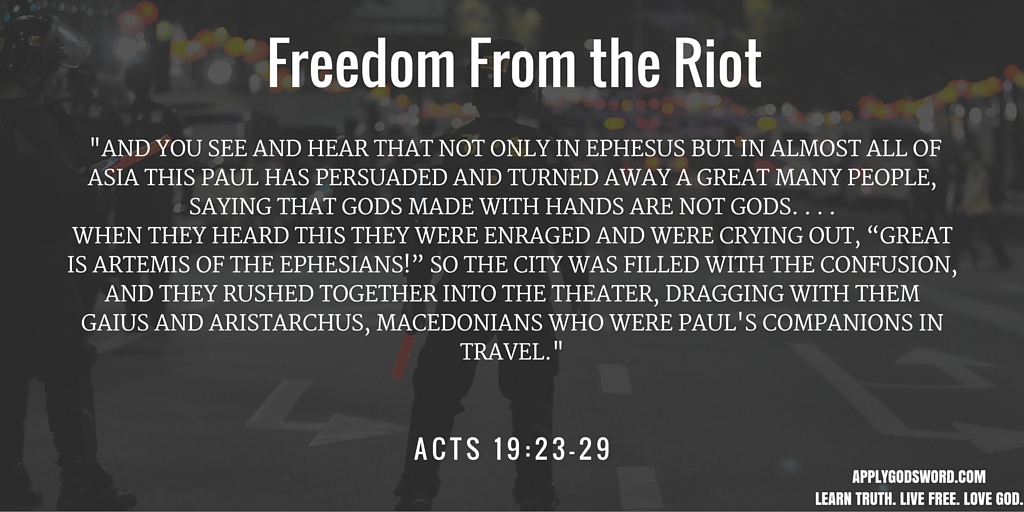
Each of us has those untouchable topics in our life. Whenever they are brought up, whenever we are confronted there, or whenever that certain itch is not scratched, being “enraged” and “crying out” (Acts 19:28) is sure to follow.
We don’t want to yell at our spouse when they confront our eating habits. We don’t want to go into a rage when our kids break a window . . . again. Nobody wants to get into the car after a long day’s work to then fume in fury as we sit helplessly in traffic. Nobody wants to rage and yell, and yet we do far more often than we would like to admit. Why?